
5 Takeaways from the 2026 Annual AASV Meeting
What are Thought Leaders in Swine Health Focusing on Today?
By Brian Arnold, Sr. Product Manager – Direct Fed Microbials
The 2026 American Association of Swine Veterinarians (AASV) Annual Meeting revealed a clear shift—disease is still the top concern, but the tools to fight it are rapidly evolving. Biosecurity is becoming data-driven, diagnostics are accelerating decision-making, and nutrition is emerging as a frontline health strategy.
1. PRRS Is Still the US Swine Industry’s #1 Constraint
What We Saw:
- PRRS related content made up the single largest share of the meeting—covering elimination strategies, outbreak management, regional control, diagnostics, vaccination timing, and biosecurity reinforcement.
What This Means For Producers:
- PRRS is a system level risk with cascading impacts on mortality, performance, labor, and antibiotic use.
- Veterinarians are pushing producers toward earlier detection, tighter stabilization timelines, and regionally aware decision making.
- Investments that reduce PRRS pressure upstream (biosecurity, immunity support, diagnostics) are increasingly seen as profit protection, not added cost.
2. Biosecurity is Shifting from Protocols to Proof
What We Saw:
- Heavy emphasis on transport biosecurity, vehicle movement tracking, mortality handling, rendering vs composting, downtime compliance, and environmental contamination—not just barn entry rules.
What This Means For Producers:
- Biosecurity weak points are being found outside the barn: trucks, dead stock handling, shared equipment, and people movement.
- Producers should expect more scrutiny around transport sanitation, downtime enforcement, and mortality management practices.
- Systems that can reduce pathogen load in the environment (air, surfaces, manure, pits, trailers) are becoming part of the biosecurity conversation—not optional add ons.
3. EarlyLife Health Sets the Ceiling for Performance
What We Saw:
- Strong focus on enteric disease, nursery mortality, weaning age, piglet vitality, gut health, and sowtonursery data linkages.
What This Means For Producers:
- The industry is moving beyond “fix it in the nursery” thinking—earlylife stress and gut disruption limit lifetime performance.
- Veterinarians are prioritizing strategies that support piglet resilience, not just treatment response.
- Anything that improves early gut integrity, immune readiness, and consistency at weaning has outsized ROI downstream.
4. Nutrition Is Positioned as a Health Tool
What We Saw:
- Significant work focused on gut health modulation, direct-fed microbials as a tool for health, and mycotoxin mitigation strategies.
What This Means For Producers:
- There is a clear trend toward nutritional intervention replacing or supporting traditional pharmaceutical interventions.
- Producers that win are including nutrition as part of a comprehensive health strategy.
*Industry spotlight: New Strategies to Combat F18+ E. Coli in Nursery Pigs
Post-weaning diarrhea continues to challenge nursery performance — and rising antibiotic resistance is making control even more complex. New research is shedding light on alternative strategies that target how F18 E. coli colonizes and impacts the gut, offering a fresh perspective on improving survivability in challenged pigs. Click here for the Farm Journal’s Pork article
5. Data, Diagnostics, and Precision Tools Are Becoming Table Stakes
What We Saw:
- Expanded use of diagnostic innovation, population level surveillance, granular production data, AI assisted monitoring, and systemwide analytics.
What This Means For Producers:
- The industry is shifting from reactive diagnostics to predictive and preventive intelligence.
- Producers who can integrate health, production, and movement data will have a clear advantage in decision speed and disease response.
- Technologies that simplify data collection—or turn existing data into actionable insights—are no longer “nice to have.”
AASV 2026 made it clear: the future of swine health lies in preventing challenges before they occur—through smarter biosecurity, stronger early life resilience, comprehensive health strategies that include nutrition, and better use of data to guide decisions.
AASV 2026 By the Numbers*
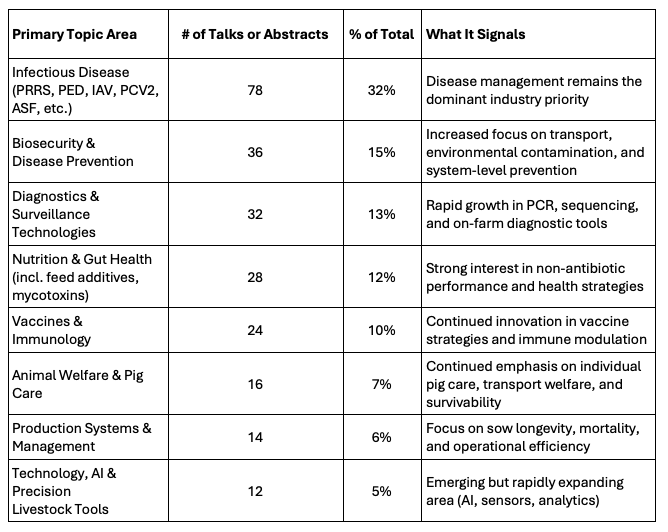
*Results AI generated from a review of 2026 AASV proceedings.