
What Pushes Them Over the Edge? Rethinking Disease in Cows and Calves
What Pushes Them Over the Edge? Rethinking Disease in Cows and Calves
By Samanta Fensterseifer, DVM, MSc, Staff Research Scientist
When we think about disease in cows and calves, it’s common to picture a single pathogen causing a single problem. But in reality, it’s often not that simple.
What is a Coinfection?
A coinfection happens when two or more pathogens infect the same animal at the same time. These pathogens can be bacteria, viruses, or parasites, and they don’t act independently – they interact with each other and with the animal’s immune system. This interaction can make disease more severe, longer-lasting, and harder to manage.
Coinfections are More Common than We Think
In human medicine, studies suggest that up to 30-80% of infections may involve more than one pathogen. In livestock, coinfections are likely just as common – if not more – but often go undetected. Why? Because most diagnostic approaches look for one pathogen at a time. Once something is found, testing often stops. That means we may be missing the bigger picture.
Recent large-scale surveillance data using our advanced PathKinex molecular tool is starting to change that.
What We’re Seeing in Cows and Calves
Using pathogen surveillance data from dairy systems, a clear pattern has emerged:
- 61% of cows and calves carried two or more pathogens at the same time
- The presence of multiple pathogens is associated with a higher likelihood of disease symptoms
In other words, coinfection isn’t the exception – it’s very common.
More Pathogens, Higher Disease Risk
Across livestock species, one consistent trend appears: as the number of pathogens increases, the risk of disease also increases.
Certain combinations of pathogens seem especially important. When bacteria like E. coli, Clostridium perfringens, and Salmonella are present together, the likelihood of clinical symptoms rises significantly compared to when none are detected (Figure 1). This suggests that disease is often not caused by a single “bad actor,” but rather by a group of pathogens working together.
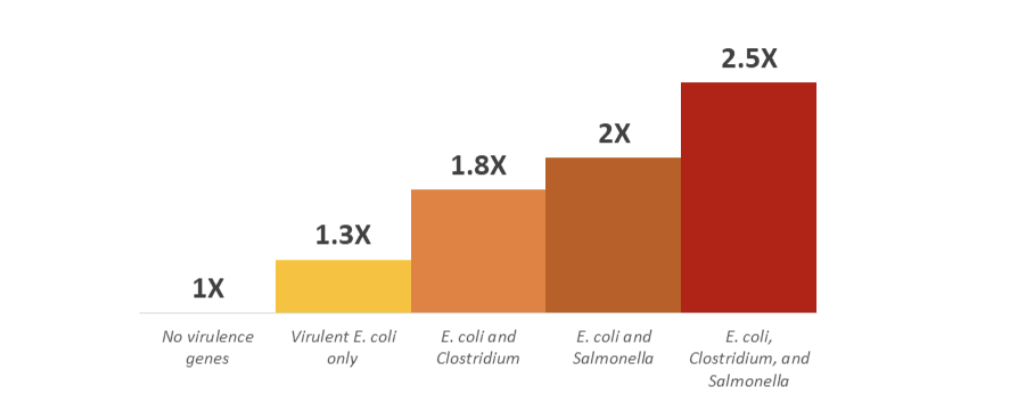
Figure 1. Relative risk of symptoms in dairy cows when one or more pathogen marker genes were detected in rectal swab samples. (n= 1801 dairy cows from 93 farms; 557 cows were classified as symptomatic and 1244 as healthy)
A Closer Look: Large-Scale Data from U.S. Dairy Herds
To better understand how pathogen load relates to animal health, a large-scale study with samples collected between 2018 and 2024 was presented at the 2025 American Dairy Science Association (ADSA) meeting. The study evaluated 2,026 dairy cows and heifers from 88 commercial farms across 19 states.
Animals were classified based on health status:
- 636 animals were considered sick, showing signs such as diarrhea, ketosis, displaced abomasum, or off-feed events
- 1,390 animals were classified as healthy
Using qPCR-based diagnostics, researchers didn’t just detect pathogens – they quantified them. This allowed for a more precise look at how pathogen load changes with health status and stage of lactation.
What the Research Tells Us About Sick Animals
The results clearly support the coinfection concept: cows and heifers with gastrointestinal or metabolic disease had significantly higher levels of multiple pathogens, including total E. coli as well as enteropathogenic E. coli, Clostridium perfringens type A and Salmonella.
This reinforces a key idea that higher pathogen loads in dairy cows exacerbate disease symptoms, lower productivity, and increase financial losses. Rather than a single pathogen driving disease, it’s the combined burden of multiple organisms that is closely tied to health challenges.
The Transition Period: A Critical Window
One of the most important findings for dairy producers is that pathogen load isn’t constant – it changes with stage of lactation.
Regardless of visible disease symptoms, cows in the transition period (especially fresh and dry) carried the highest pathogen loads compared to mid-lactation. Several pathogen markers for enteropathogenic E. coli were increased in transition cows, as well as Clostridium perfringens type A and surprisingly, the coccidia Eimeria bovis.
This provides insight into why transition cows are more vulnerable:
- The immune system is under stress
- Feed intake and metabolism are changing
- And at the same time, pathogen pressure is elevated
It’s a perfect storm.
Don’t Forget Calves: Where Coinfections Often Begin
While much of the data comes from cows, the same principles strongly apply to calves – especially in early life. Calves are particularly susceptible to coinfections because:
- Their immune system is still developing
- They are exposed to new environmental pathogens
- Multiple stressors like transport, grouping, and diet changes are common
In calf scours, for example, it’s very common to see multiple pathogens at the same time. These combinations can worsen severity, prolong recovery, and increase the risk of secondary challenges.
There is also growing recognition of the gut-lung axis – where gastrointestinal health influences respiratory health. This helps explain why calves with poor gut health early in life may also be more susceptible to pneumonia later on. In that sense, early-life coinfections don’t just impact short-term health – they can have long-term consequences on performance and survivability.
Why This Matters for Management
If disease is driven by multiple pathogens – not just one – then our approach to prevention and treatment also needs to evolve.
While there’s no single “silver bullet,” effective strategies tend to include a PROgram approach:
- PREVENT: Entry and spread of pathogens (biosecurity, sanitation, environmental hygiene)
- REDUCE: The overall pathogen load, not just targeting one organism (feed and water hygiene, mycotoxin mitigation, direct and indirect pathogen inhibition tools)
- OPTIMIZE: Immunity and gut health (protect gut health and integrity – since many of these pathogens originate in the gastrointestinal tract, promote gut microbiota diversity, support the immune system, especially during high-risk periods, and minimize stressors)
Taking A Broader View of Health
Coinfections challenge the way we traditionally think about disease. Instead of asking, “What pathogen is causing this problem?”, a better question might be: “What combination of pathogens – and other stressors – is pushing this animal past the tipping point?”
By recognizing the role of coinfections, producers and veterinarians can take a more proactive and comprehensive approach to herd health – especially during high-risk periods like transition and early life.
Learn More About MultiLayer Approaches to Dairy Cow and Calf Health and Pathogen Management:
- United Animal Health Solutions
- Study reference: Lange et al., 2025. J. Dairy Sci. Vol 108(Suppl. 1):374 (Abstr.) (https://www.adsa.org/Portals/0/SiteContent/Docs/Meetings/2025ADSA/Abstracts_BOOK_2025_20250624-1249.pdf)