
Managing Seasonal Heat Stress in Swine Production: Turning Summer Pressure into Performance Opportunity
By Brian Arnold, Sr. Product Manager – Direct Fed Microbials
The Challenge: Heat Stress Erodes Performance and Profit
Heat stress is one of the most predictable—and costly—seasonal challenges in swine production. Pigs operate within a thermoneutral zone of roughly 55°F–70°F, and deviations above this range trigger immediate biological and behavioral responses.
Key impacts under heat stress:
- Reduced average daily feed intake, ~9% reduction in ADG in meta-analysis1
- Decreased growth rate (ADG), ~12% drop in ADG in meta-analysis1
- Reduced feed efficiency
Example performance shift under heat stress:
In a late finishing trial conducted by United Animal Health, a simulated heat stress challenge was created to determine impact on growth performance. A treatment group was exposed to induced heat stress during Days 15–36 (20 days). Performance impact was determined by comparing heat stress pigs to a negative control group.
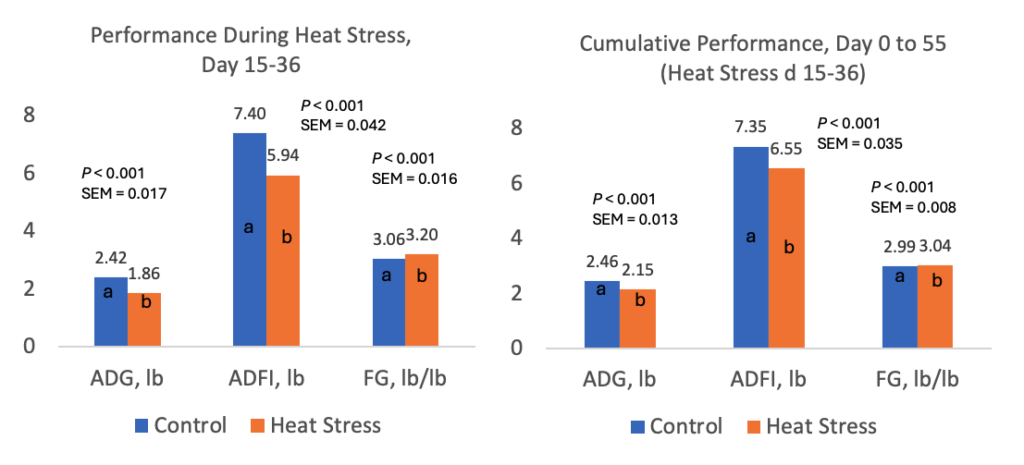
Results show:
ADG: 2.42 → 1.86 lb/day
ADFI: 7.40 → 5.94 lb/day
F:G: 3.06 → 3.20
The Biology: Why Heat Stress Limits Performance
To maintain body temperature, pigs:
- Reduce metabolic heat production
- Reduce feeding behavior
- Shift meal patterns (smaller, shorter, less efficient)
At elevated temperatures (~91°F vs. 73°F):
- Feed intake drops ~30% (3.27 → 2.30 lb/day)
- Daily gain drops ~37% (2.17 → 1.37 lb/day)
Bottom line:
Performance loss is driven primarily by reduced intake and energy consumption, not just inefficiency.
Nutritional Strategy #1: Increase Energy Density with Fat
Fat is one of the most effective nutritional tools during heat stress.
Why fat works:
- High energy density
- Lower heat of digestion
- Improved feed efficiency
Across 11 UAH trials:
- +3.6% ADG (average)
- −6.1% improvement in F:G
- Reduced feed intake with improved efficiency
Example response at different fat levels:
- 2% fat → ~4.7% ADG improvement
- 3.5% fat → ~6.9% ADG improvement
- 4% fat → ~7.2% F:G improvement
Trial confirmation:
- Feed efficiency improved consistently (e.g., 3.67 → 3.43 F:G)
- ADG and final weights increased modestly
Key insight:
Fat consistently improves efficiency, but ADG response is variable and context-dependent (health, intake, density, etc.).
Nutritional Strategy #2: Manage Fiber and Protein Heat Load
Fiber and protein increase heat increment, which becomes detrimental under heat stress.
Observed effects:
- Increasing fiber raises total heat production
- Higher crude protein diets increase metabolic heat load
Performance under heat with diet adjustments:
- Lower CP + amino acid diets reduced heat production
- High-fat, lower-fiber diets improved ADG and F:G in hot conditions
Key insight:
In summer conditions, reducing heat increment becomes as important as meeting nutrient requirements.
Nutritional Strategy #3: Optimize Energy for Seasonal Conditions
Energy density matters more in summer than winter.
Example:
- Increasing energy improved ADG by ~6.4% in summer
- No improvement observed in winter
Key insight:
Energy density strategies should be seasonally adjusted, with greater emphasis during heat stress periods.
Management Levers Beyond Nutrition
1. Space & Stocking Density
- More space increases ADFI and ADG
- Higher density reduces performance
- Strategic removal of pigs improves outcomes
2. Time & Market Strategy
- +3 days on feed can reduce feed cost by ~$2/pig
3. Pelleting
- Improves F:G by 3–8%
- Requires careful feed management to avoid out-of-feed risks
Reality Check: Economics Matter
While fat improves performance:
- Feed cost increases with higher fat inclusion
- IOFC may decline at higher fat levels despite performance gains
Key insight:
Performance ≠ profitability without economic optimization. Tools like margin models are essential to balance cost vs. return.
Putting It All Together: Summer Strategy Framework
To manage heat stress effectively:
1. Protect Intake
- Recognize immediate drop in voluntary feed intake
- Adjust diets to compensate for reduced consumption
2. Increase Energy Density
- Add fat (2–4% typical range)
- Target improved feed efficiency and energy intake
3. Reduce Heat Load
- Lower fiber where possible
- Optimize protein/amino acid balance
4. Manage Environment & Space
- Reduce overcrowding
- Adjust marketing/pen management strategies
5. Optimize Economics
- Align diet decisions with margin outcomes—not just performance
Bottom Line
Heat stress is predictable, measurable, and manageable.
Producers who proactively adjust:
- Energy density
- Diet formulation
- Space and marketing strategy
…can mitigate seasonal losses and maintain profitability.
Take the Next Step
Heat stress doesn’t just reduce performance—it reshapes the biological and economic rules of production. The right nutritional and management adjustments can turn a seasonal risk into a controllable variable.
Learn more about how United Animal Health research insights related to managing seasonal challenges for improved grow-finish profitability. Learn more about our Swine Solutions or contact a United Animal Health account manager today.
References:
- da Fonseca de Oliveira AC, Vanelli K, Sotomaior CS, Weber SH, Costa LB. Impacts on performance of growing-finishing pigs under heat stress conditions: a meta-analysis. Vet Res Commun. 2019 Feb;43(1):37-43. doi: 10.1007/s11259-018-9741-1. Epub 2018 Dec 19. PMID: 30569275.