
Healthier Gut, Healthier Lungs?
Exploring the Relationship Between Gut and Respiratory Health in Dairy Calves
By Samanta Fensterseifer, DVM, MSc, Staff Research Scientist
Respiratory disease and diarrhea are two of the most common health challenges affecting young dairy calves. They are often treated as separate problems, but growing research suggests they may be more connected than we once thought.
Scientists now recognize an important relationship known as the gut-lung axis, the two-way communication channel between the gastrointestinal and respiratory tracts via their shared mucosal system. Because much of a calf’s immune system develops in the gut, changes in the intestinal microbiome can influence immune responses throughout the body, including the lungs.
This raises an important question: Can improving gut health early in life also improve respiratory health?
More than a Digestive Organ
During the first weeks of life, a calf’s gastrointestinal tract undergoes rapid development. At the same time, the immune system is still maturing. This combination makes young calves more susceptible to infectious diseases, especially diarrhea and early onset of pneumonia.
A healthy gut microbiome helps train and modulate the immune system, supports the intestinal barrier, and limits the growth of harmful bacteria. When this delicate balance is disrupted, opportunistic pathogens can multiply and inflammation can increase, leaving the calf more vulnerable to disease.
Recent research suggests these effects are not limited to the gut. Signals produced by intestinal microbes can influence immune cells that circulate throughout the body. In this case, communication along the gut-lung axis can lead to the respiratory system facing the impacts of certain changes in gut health.
Evaluating the Gut-Lung Connection in the Field
To better understand whether supporting the gut microbiome could influence calf health, we evaluated a Bacillus-based direct-fed microbial (DFM) fed in milk replacer on a commercial dairy farm. The study followed 1,469 dairy calves during their first 20 days of life and was presented at the 2026 ADSA Annual Meeting. Calves received the same milk replacer program, but one group was supplemented with the Bacillus-based DFM (621 calves) while the remaining calves served as controls (848 calves). The study was conducted using alternating 60-day feeding periods (on/off feeding strategy) under normal commercial farm management conditions.
In addition to monitoring health events, rectal swab samples from a subset of calves were analyzed using quantitative PCR (qPCR) to measure common gastrointestinal pathogens and microbial virulence genes.
Finding #1: Fewer Cases of Pneumonia During the First Weeks of Life
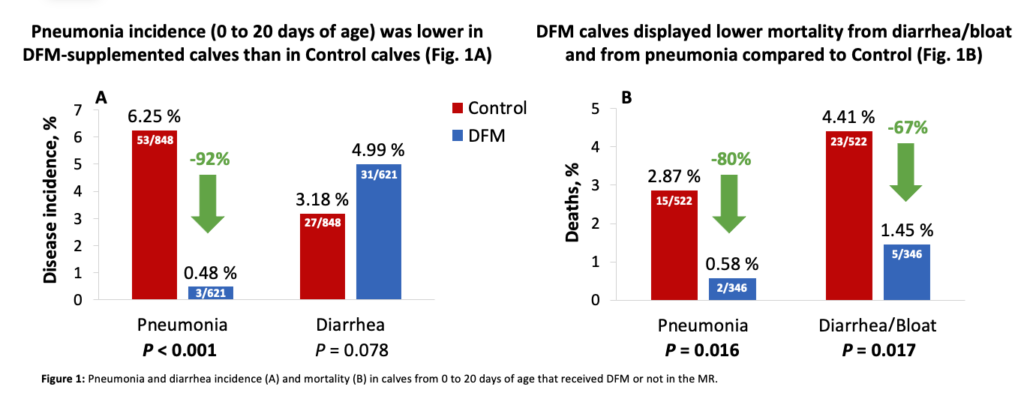
The most striking finding from the study was a dramatic reduction in respiratory disease. Calves receiving the Bacillus-based DFM experienced substantially fewer cases of pneumonia during the first 20 days of life compared with control calves (Figure 1A).
Mortality also improved: Deaths associated with pneumonia were significantly lower in calves receiving the DFM. Mortality attributed to gastrointestinal diseases like diarrhea and bloat was also reduced when the Bacillus-based DFM was in the milk replacer (Figure 1B).
Interestingly, the number of calves diagnosed with diarrhea tended to be slightly higher in the supplemented group. However, these calves were less likely to die from gastrointestinal disease, suggesting that while digestive disturbances still occurred, their overall severity may have been reduced.
Finding #2: Changes in the Gut Microbiome Accompanied Health Improvements
The improvements described previously were associated with measurable changes in the intestinal microbial community.
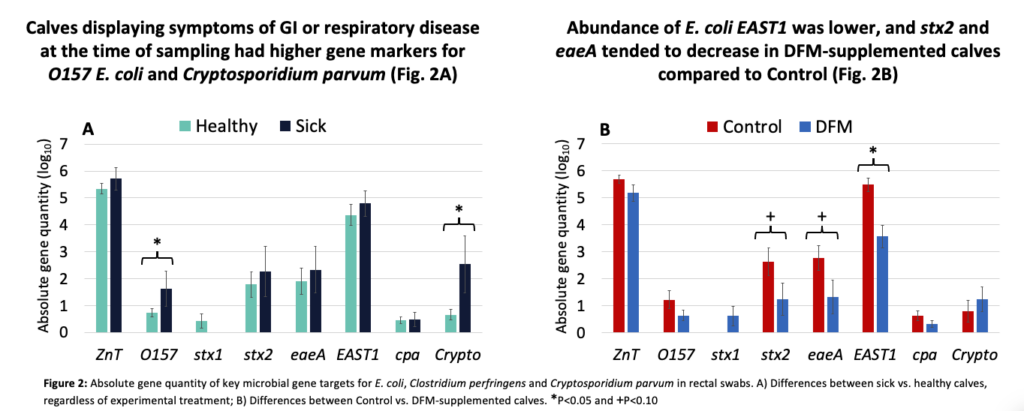
Sick calves showing signs of either gastrointestinal or respiratory disease carried higher levels of Cryptosporidium parvum and pathogenic Escherichia coli O157 compared with healthy calves (Figure 2A). Among calves receiving the Bacillus-based DFM, several important E. coli virulence genes were reduced. These included EAST1 (a toxin associated with intestinal fluid secretion and diarrhea), stx2, and eaeA (Figure 2B). These genes are commonly associated with intestinal damage and increased disease severity.
Together, these findings suggest that supporting beneficial bacteria in the gut may help reduce populations of potentially harmful microorganisms.
Healthier Gut, Healthier Lungs?
For many years, probiotics have primarily been viewed as tools to support digestive health. However, these results suggest that probiotic benefits can extend beyond the gastrointestinal tract.
Improving the balance of the gut microbiome may influence immune function throughout the body, helping calves better respond to both enteric and respiratory challenges during one of their most vulnerable life stages.
This is particularly important because the first few weeks of life represent a critical window for immune development. Management practices that support gut health—including excellent colostrum management, proper nutrition, hygiene, vaccination programs, and strategies that promote a healthy microbiome—may help improve calf resilience against multiple disease challenges
Rather than viewing diarrhea and pneumonia as completely separate diseases, it may be more useful to ask a broader question: How can we build a healthier calf from the inside out? While additional research is needed to better understand the biological mechanisms involved, the growing evidence surrounding the gut-lung axis suggests that supporting the gastrointestinal microbiome may be an important piece of that answer.
References
Budden, K. F., Gellatly, S. L., Wood, D. L. A., Cooper, M. A., Morrison, M., Hugenholtz, P., & Hansbro, P. M. (2017). Emerging pathogenic links between microbiota and the gut–lung axis. Nature Reviews Microbiology, 15, 55–63. https://doi.org/10.1038/nrmicro.2016.142
Fensterseifer, S., Lange, A. M., Busato, S., Arias, R. P., & Galbraith, E. A. (2026, June 21–24). Effects of a Bacillus-based probiotic in calf milk replacer on pneumonia incidence and early-life mortality [Abstract]. American Dairy Science Association Annual Meeting, Milwaukee, WI, United States.
Gaudino, M., Nagamine, B., Ducatez, M. F., & Meyer, G. (2022). Understanding the mechanisms of viral and bacterial coinfections in bovine respiratory disease: A comprehensive literature review of experimental evidence. Veterinary Research, 53, Article No. 70. https://doi.org/10.1186/s13567-022-01086-1
Mach, N., Monié-Ibanes, M., Sikht, F. Z., Hygonenq, M., Pot, G., Robert, H., Bars, D., Farizon, Y., Richard, E., Nouvel, X., Citti, C., Baranowski, E., Ducatez, M., & Meyer, G. (2025). Decoding the dynamics of calves’ respiratory and gut microbiota: Exploring stability, resistance, and individual patterns. Animal Microbiome, 7, Article No. 126. https://doi.org/10.1186/s42523-025-00494-w
Zuckermann, F. A., Husmann, R., Chen, W., Roady, P., Pfeiff, J., Leistikow, K. R., Duersteler, M., Son, S., King, M. R., & Augspurger, N. R. (2022). Bacillus-based direct-fed microbial reduces the pathogenic synergy of a coinfection with Salmonella enterica serovar choleraesuis and porcine reproductive and respiratory syndrome virus. Infection and Immunity, 90(4), Article e00574-21. https://doi.org/10.1128/iai.00574-21