
By Dr. Hector Leyva-Jimenez, Manager – Global Technical Services & Dr. Adrienne Woodward, Associate Director – Swine Product Technical Services
As poultry production systems become increasingly efficient, understanding and managing hidden biological pressures is becoming just as important as addressing visible health challenges. Mycotoxins are a particularly important issue for commercial poultry production worldwide. Their effects can extend beyond visible clinical signs and may influence growth, feed efficiency, immunity, reproductive performance, and overall flock profitability. Because contamination is difficult to avoid completely and rarely occurs in isolation, successful management requires a comprehensive approach that combines prevention, monitoring, quality control, and mitigation.
What are Mycotoxins?
Mycotoxins are secondary fungal metabolites produced by certain molds that grow on feed ingredients. These compounds contaminate corn, wheat, barley, sorghum, soybeans, oats, rice, and other feedstuffs commonly used in poultry diets.1 Because commercial poultry production depends heavily on grain-based feeds, mycotoxins remain a constant challenge for animal protein producers globally. Warm temperatures, humidity, drought stress, plant damage, and poor storage conditions can increase the risk of fungal growth and mycotoxin contamination. Even when feed or ingredients appear normal, harmful toxins that are difficult to detect without proper testing may still be present.
The Mycotoxins that Matter Most
The most important mycotoxins affecting poultry include aflatoxins (AFL), fumonisins (FUM), deoxynivalenol (DON or vomitoxin), T-2 toxin, ochratoxin A (OTA), and zearalenone (ZEA).1 Each toxin can affect birds differently:
- AFLs, produced primarily by Aspergillus fungi, are often considered among the most damaging because they can impair liver function, suppress immunity, and reduce growth. Aflatoxins have been linked to various negative consequences in birds, such as impaired performance, weakened immune system, damage to organs, and decreased egg production.
- FUMs are commonly associated with cellular metabolism and gut health.
- DON and T-2 toxin belong to a group called trichothecenes, which can reduce feed intake and damage intestinal tissues.
- OTA can negatively affect kidney function.
- Other mycotoxins, such as ZEA, may also impair production. ZEA is known for its estrogen-like effects. Although poultry species are generally less sensitive to ZEA than some other livestock, this mycotoxin remains a concern, as in high doses, ZEA causes reproductive failure, liver damage, and gut inflammation.2
Challenges Rarely Stem from a Single Toxin
Mycotoxin risk in commercial production is seldom limited to one toxin at a time. In most cases, multiple toxins are present simultaneously, and their combined impact can be greater than expected. Feed ingredients are usually contaminated with two or three mycotoxins, according to United Animal Health’s annual survey data, which increases challenge severity and complexity. This interaction helps explain why some flocks show health problems despite feed analyses that indicate toxin levels below traditional cautionary thresholds.
The relationship between mycotoxins and immunity is another contributing factor to challenge complexity. Poultry producers invest heavily in vaccination programs and biosecurity measures. However, mycotoxins can weaken immune responses, making birds less able to respond effectively to vaccines or resist infectious diseases. Additionally, commensal pathogens like E. coli or Clostridium that are present in the feed or ingredients can interact with mycotoxins, resulting in even further performance loss and ultimately increasing the mortality rate. A flock facing both pathogenic challenges and mycotoxin exposure may experience greater losses than would occur from either problem alone.
The Hidden Cost of Subclinical Exposure
Mycotoxins are often considered a hidden cost of production, one that may only become apparent when flock performance and profitability are evaluated holistically. This is because mycotoxins’ economic impacts extend far beyond obvious mortality losses. In a commercial broiler operation, producers expect birds to grow quickly and convert feed into meat efficiently. Mycotoxins can interfere with this process by damaging the intestinal tract, reducing nutrient absorption, and increasing oxidative stress. As a result, birds may gain less weight, require more feed per pound of growth, and become more susceptible to disease challenges. Reduced growth, poorer feed conversion, increased veterinary costs, weaker immune function, processing losses, and reduced product quality all contribute to economic damage.
Because feed represents about 70% of poultry production cost, even modest reductions in feed efficiency can meaningfully affect profitability. A 2025 meta-analysis by Kolawole et al. 3 estimated that for every 100,000 birds fed mycotoxin-contaminated diets (including AFL, FUM, DON, OTA, and T-2 at different combinations), 5.89 kg of feed per bird per production cycle were required. Compared to 5.31 kg of feed for control birds, mycotoxin contamination led to a 10.9% increase in feed consumption. Using the study’s feed cost assumptions, this reduction in feed efficiency resulted in an annual feed expenses increase of $234,000 USD per 100,000 birds.
Importantly, this estimate reflects only the direct cost of the extra feed required to maintain production performance. Secondary losses, such as veterinary treatments, health management expenses, increased disease susceptibility, and mortality, among others, can also drive up costs for producers during a mycotoxin challenge.
Layers and breeders can also be affected. In laying hens, mycotoxins may reduce egg production, impair shell quality, and negatively influence bird health. Breeder flocks exposed to toxins may have poorer reproductive performance and compromised chick quality. Since breeding flocks represent a significant investment, even moderate losses can have important economic consequences throughout the production chain.
Recent mycotoxin research has revealed that the greatest economic burden may stem from subclinical exposure rather than obvious disease events. Birds could continue to consume feed and appear clinically normal while experiencing reductions in nutrient utilization, immune responsiveness, or feed efficiency. Over time, these seemingly modest performance losses accumulate into significant financial consequences.
Building a More Complex Mitigation Strategy
Complete avoidance of mycotoxins is difficult, so mitigation strategies are an important part of poultry feed and flock management. Feed additives specifically designed to reduce the impact of mycotoxins have become valuable tools. Clay-based adsorbents and yeast-derived products can help reduce the absorption of certain toxins in the digestive tract. Enzymes and specialized microorganisms may transform some mycotoxins into less toxic compounds. Other additives contain antioxidants, plant extracts, vitamins, or supportive ingredients that help birds better cope with toxin-induced stress.
However, because mycotoxin exposure often occurs alongside other commercial stressors, mitigation strategies should focus on more than reducing toxin availability. An effective approach will also support intestinal function, microbial balance, and appropriate immune response. As no single technology can address all these biological challenges, integrated strategies that combine complementary modes of action continue to draw interest.
One such strategy was evaluated by UAH in six broiler trials concerning AFL and FUM challenge diets. This integrated approach combined:
- Specialized aluminosilicate clay selected to adsorb mycotoxins in the GI tract
- Yeast cell wall to support intestinal integrity and ameliorate select microbial challenges
- Multi-strain Bacillus probiotic intended to support microbial balance, contribute antifungal and antimicrobial activity, and promote appropriate immune function
Across the six trials, birds receiving the integrated mitigation strategy recovered, on average, 37.3% of lost growth performance and 29.3% of lost feed efficiency relative to control birds (Figure 1).
These findings suggest that a multi-faceted mitigation strategy can help reduce the production losses associated with mycotoxin exposure in part by improving the efficiency with which feed is converted into body weight. Impaired feed conversion is a major cost driver attributed to mycotoxins, so consistent recovery can meaningfully offset the financial impact of feed contamination and support more predictable flock performance under commercial conditions.
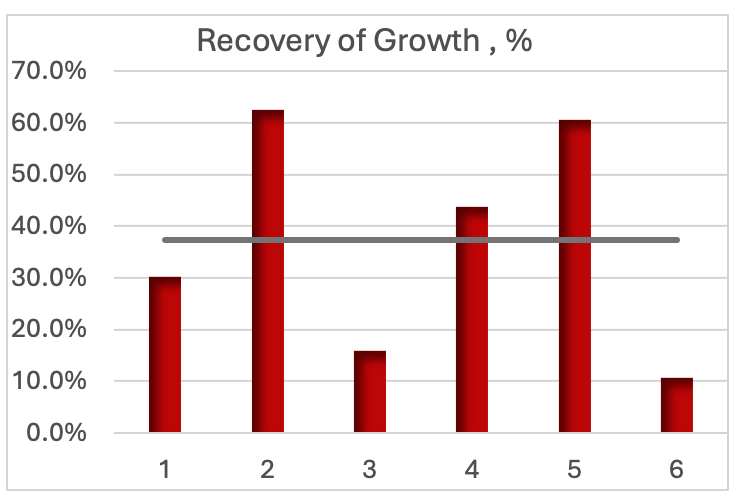
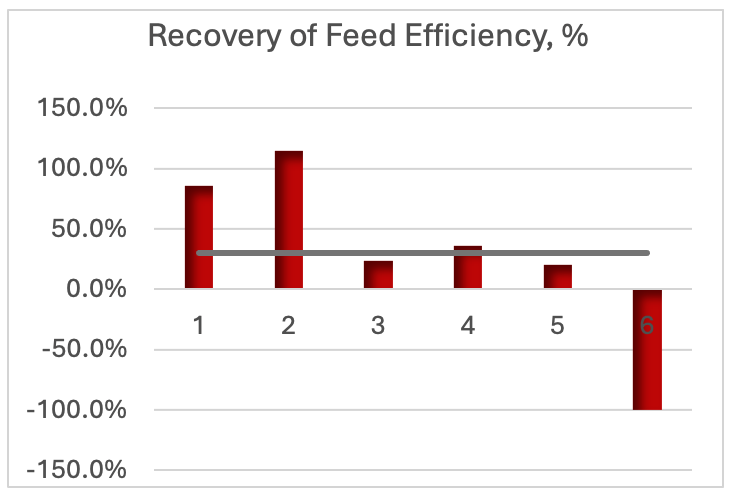
Figure 1. Growth performance recovery of broilers fed high-toxin diets using a multi-component mycotoxin mitigation strategy. The bold gray horizontal line represents average recovery over the six trials.
Key Takeaways for Producers
- Mycotoxin contamination rarely involves a single toxin.
- Subclinical exposure can create significant economic losses even when birds appear healthy.
- Performance impacts often result from interactions among mycotoxins, pathogens, and environmental stressors.
- Effective management requires a combination of prevention, monitoring, testing, and mitigation strategies.
Works Cited
- Guerre, P. (2016). Worldwide mycotoxins exposure in pig and poultry feed formulations. Toxins, 8(12), 350. https://doi.org/10.3390/toxins8120350
- Okasha, H., Song, B., & Song, Z. (2024). Hidden hazards revealed: Mycotoxins and their masked forms in poultry. Toxins, 16(3), 137. https://doi.org/10.3390/toxins16030137
- Kolawole, O., Valliere, C., Krska, R., David, M., Lorran, G., Schatzmayr, D., Schatzmayr, G., Eskola, M., Petchkongkaew, A., & Elliott, C. (2025). Potential economic and environmental impacts of mycotoxins in poultry: A meta-analysis and life cycle assessment approach. Environmental Impact Assessment Review, 115, Article No. 107989. https://doi.org/10.1016/j.eiar.2025.107989